The Natchez in Second Life, designed by Gospel Voom
A while ago, I addressed the question of Trust: The Content Creators and the Open Source Grids in the light of the brouhaha that was going on around Legend City, one of the Open Source Grids. I happen to believe in Open Source grids as an important development that will shape the future of the metaverse – not through some starry-eyed belief in Open Source per se, but in the fact that it, along with the work of the Lab and other online games, will shape the future of the metaverse. No biggie there.
I recently spoke at a charity conference on social networking (The Social Media Exchange, if you’re interested, and you can see my presentation – Real Opportunities in Virtual Worlds here), and we moved from the normal nervous questions (“I’ve read about … you know … sex in Second Life” to excitedly discussing the opportunities where every small charity could have their own grid linked to the wider metaverse, just as now their web-site connects them to the internet … and the internet to them.
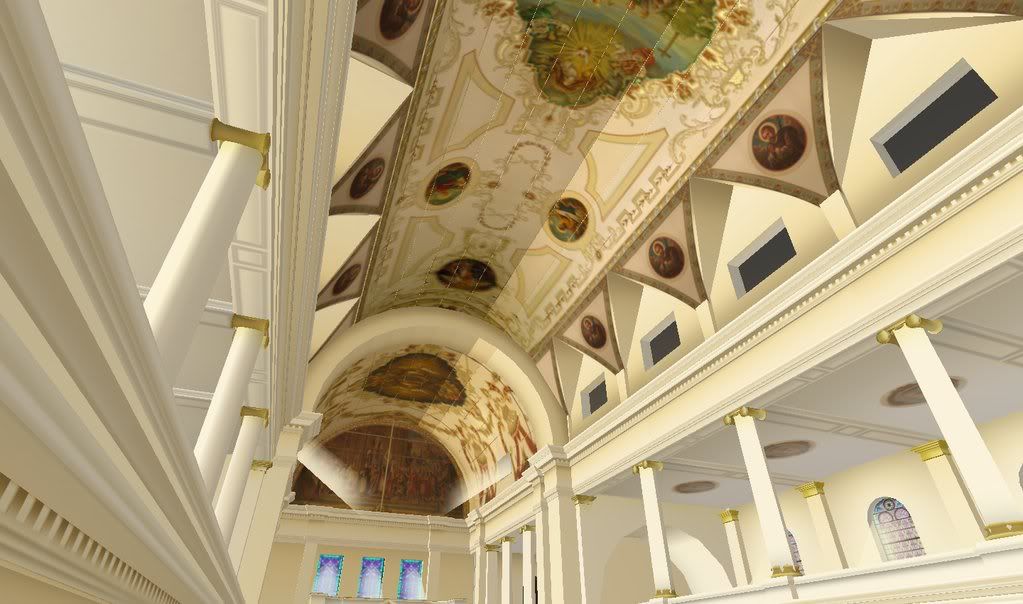
Cathedral in original New Orleans, designed by Gospel Voom
But – and it is a big neon coloured <h1>-sized BUT … there are things to be established if any grid is to survive and play a part in the future of the metaverse.
Like, an economy.
And the prevention of copyright violations.
Yesterday I was contacted by Gospel Voom, a very talented professional creator in Second Life, who has worked on many of the top University builds in Second Life, as well as other educational and commercial projects. One of those he was justifiably proud of was the creation of a virtual New Orleans, complete with Cathedral, Bourbon Street and a beautifully detailed paddle steamer, the Natchez. He was commissioned in January 2008, and this fantastically rich project was completed in June 2008. We actually mentioned it in the May 2008 issue of Prim Perfect (See News from the Grid, page 6), and also here on the blog, where Diva wrote about the cathedral. Every prim in the build was created by Gospel himself, except the streetlamps which were sculpted by Animov Marvin, and the Lilith Heart flowers that were added by the owners.
Orleans Blue tramcar in OpenLife
When he signed off on the project, he discussed permissions with the owners. Like many creators, Gos was anxious to protect his intellectual property, and not prepared, therefore, to grant full permissions (copy, modify, transfer). Modify is useful for an owner to have … if they need to make tweaks to a property or accommodate a tenats’s wishes. Transfer allows the whole build to be sold as a going concern. Copy allows an infinite number of products to be made. It could be useful if, for example, you wanted to put the same residential build on a second sim. Gos explained at the time to his clients which permissions he was prepared to grant, and where he would charge extra for their usage.
He has passed me a copy of the notecard (dated 29th April 2008) where he clarified his position on this clearly:
Handover of buildings at Orleans and object permissions.
In order to clear up any confusion that may exist between your expectations versus my obligations I thought I’d reiterate the procedure here.
Cathedral inOpenLife - Gos not listed as creator
History: Upon completion of each stage we agreed that I would deed each build to you along with a backup copy. Initially, I was going to supply you with copy/mod/no trans versions but after discussing with you other specialist city Sim builds like Amsterdam; which were sold for 50,000USD, I suggested that I should instead deed the build in places as mod/no copy/trans along with a back-up with the same permissions.
Note: It is important to note that at no point were full mod/copy/trans permissions made a pre-requisite of the build. Had they been, my charges would have been based on not only building a Sim but also in creating for you a business for the sale and distribution of famous New Orleans buildings and attractions. As it was my charges were based on building an EXCLUSIVE Sim for you to use and to be able to sell on with all the builds in place if you so wished. As the creator it is naturally incumbant upon me to prevent the re-distribution of content that a client has paid the exclusive rights to use … else put my hard earned reputation at risk and incur legal action against me. This is the same scenario for all creative services and one I have been working with for the last 14 years.
New Orleans Cathedral, created by Gos, in Second Life
Yesterday you mentioned that you expected to have copy rights when we were discussing placing shotgun cottages on another sim. To reiterate my previous points I am more than happy to do so but please note that copy enabled versions are not trans. I would charge you an extra 5k to supply and place trans enabled cottages in and around the distillery. This figure includes the making of several more textures to give more variety to the builds.
I hope this clears up any confusion as to what you have actually paid for. If you do wish to open a store to sell multiple copies of any parts of your Sim at some point I’d be more than willing to discuss terms. However I’d also recommend that you only consider reselling Bourbon Street stores and never something like the St Louis Cathedral as its uniqueness should be preserved.
Yours faithfully,
Gos.
Street in 'nawlins', OpenLife, Gos not listed as creator
This is quoted in full with Gos’ permission.
When the build was complete, Gos deeded it to the clients, retaining his own name as content creator, of course. Like a responsible creator, he also supplied a back up, and he supported the build with repairs (as when someone on the staff deleted a dance floor by mistake). Then, in July, he logged in one day to find his IMs capped – all informing him that Orleans Blues had been returned, in pieces, to his Lost and Found folder. When he investigated, he found that the build had been deleted and the sim sold. When he contacted the client, she informed him that it had been losing money and she had deleted it. Gospel told her that, had he been asked, he would have been willing to help; he regarded the build (and with good reason) as his showcase.
He was slightly surprised when she then asked him for another copy of the Preservation Hall, saying she had deleted it by mistake, but he supplied it anyway.
Natchez in OpenLife, Gos not listed as creator
Later, he heard they had left Second Life – but that was the last he heard until he was told that his build had been xcreated on another grid, under the name of ‘nawlins’, and with his name no longer appearing as creator.
Gospel had at no time given permission for his build to be transferred to another grid, nor for his name to be removed as creator. Indeed, by keeping some of the permissions in his own hands, he believed that he had made it impossible for his work to be transferred to a new grid in the way that it has been.
Ironically, had Gos been approached and asked to set up the build on an open source grid, he would have agreed – for a fee (he is, after all, a professional developer). He is fully aware of the advantages of being seen as a key creator in a new grid. That gives an additional edge to his anger – his work is being placed as a quality build in an emerging world – but he has been stripped of the credit for it. This just adds insult to injury.
When Gos discovered what had happened, some of his friends travelled to nawlins on the OpenLife grid and verified that the build was there. I have seen it too, and even spoken to one of the owners of the land who told me that the majority of the builds were created in OpenLife with a few parts brought in from Second Life, using, he said, something like Second Inventory.
Natchez in Second Life, Gos listed as creator
As a matter of record, Second Inventory, as far as I am aware, only permits the transfer of objects with full permissions. The only way that objects without full permissions can be transferred, to the best of my knowledge, is by use of a copybot.
And the very use of such techniques, coupled with the failure to contact the creator to inform him what was happening or to credit him for his creations, seems to me a very serious violation of intellectual property rights and copyright.
I must say, comparing the two works side by side, I found the landowner’s explanation somewhat disingenuous. Looking at a build like the Cathedral or the steamship, it appears identical to the work that took Gos nearly five months to complete.
In Second Life, the first step would be to file a DMCA. In a sim like Open Life, the matter is less clear – and, to be honest,. the stakes are far higher. These grids are still in a fledgingly state – if they have the desire to create stable platforms that will be taken seriously by commercial businesses, they must protect content creation, thankless and troublesome as this is.
New Orleans in Second Life, created by Gos
Gos contacted the owner of the OpenLife grid, Sakai OpenLife. He has yet to receive any response.
I was able to speak to Sakai, and express my concerns. He was a little unhappy to be contacted directly, and very clear in seeing it as a private dispute between a content creator and a client which he, Sakai,and OpenLife had no role in. When I pointed out that Gos was prepared to file a DMCA for a clear violation of intellectual property rights, he suggested that this would reflect badly on the content creator – an attitude which, I am afraid, I found quite breathtakingly naive.
Building a good reputation should be at least as important to the Open Grids as building the technological architecture of their worlds is if they are ever to attract more than eager script kiddies and people eager to exploit opportunities in a number of dodgy ways. Open Grids can be exciting – but they can also be dangerous. One friend, with a great enthusiasm for OpenLife, but also considerable professional experience of the copyright laws, is appalled at what is happening:
“People just don’t understand that the SL permissions have nothing to do with IP or Copyright. I’ve posted and posted till I’m blue in the face in chat and on the forums but still people say “It is full perms so I can bring it in”. Very early on someone even went and asled a Linden and was told ‘Yes, if it is full perms you can do what you want with it.’ So I pointed out that (because of my job) I knew a damn sight more on the subject than some random Linden.”
There is an elephant in the room here. And if no-one takes it outside soon, we’re all going to be choking on the fumes of its refuse until everyone leaves the building.
~~~~~~~~~~
Inspection window to see the creator name/s and times of creation
Notes: I have included the Inspect windows on several of these graphics. These show the content creator names and also, generally, when the prims in the build were created. It can be a good way of checking whether an article has been copybotted or is a genuine creation – a slightly worrying sign is when all the prims were created at the exact same moment – although there can be legitimate reasons for that. A very healthy sign is when the prims were all created at different times or even dates – this usually indicates an ongoing construction and marks a build as genuine.
However, the fact that the OpenLife products all have their creation dates set as identical and all – incredibly – in 1970 is not in itself a sign of copybotting. OpenLife is still in beta and various problems remain to be ironed out – one of which is the problem of correctly assigning the creation dates and times. For the moment, it seems that everything on Open Life was created at the same time in January 1970!
The reason I have included Inspect windows is to show Gos’s creation process on his builds when they are in Second Life, and the fact that his name does not appear on the OpenLife builds.
I’m very much to the opinion now to just do full perms and charge accordingly for custom builds.
Charge accordingly, say, of course is a price almost nobody will pay in Second Life. Even a middling 25-30 dollars an hour is more than most people are willing to pay.
I am not a big SL developer, but I know a few who are.
I agree, if you deal with large commercial organizations (anyone willing to spend the money and time on such an elabroate build) – set a price for full-perm versions of your builds.
If they balk at the price, then insist on no-modify/copy/no-transfer versions. A prim replicator is not copybot. It doesn’t copy scripts or things like this, but it does replicate prims and is a good tool (I use one in my own building efforts.)
But, like any other tool, can be abused. However, it requires the prims you duplicate to be modifyable.
This is one reason why all my creations are transfer-only. No-mod, no-copy. If you want a copyable version, then the price doubles. If you want a modify version, the price triples and it will be copyable.
I never allow modify/transfer (no-copy) permissions. In that case, anyone who has a prim duplicator will be tempted to use it on my stuff, even if not for ill-intent, but to make back-ups forthemselves and to be able to place as many as they want.
In the case cited above, (I know, hindsight is 20/20) – might have been best to simply negotiate the full-perms thing.
Copybot is a scourge (and way too easy to find on the internet – even the SL Herald hosts a copy) – but now with Second Inventory working with Open Grin and Tribal.Net and other open grids – abuse isn’t just limited to the Agni grid any more.
This all begs the question: Should people be able to export from SecondLife to OpenGrid and PRESERVE the original creator’s name? Even if that creator does not exist in that particular openlife grid?
I personally am disinclined to invest in OpenGrid efforts at this time because scripts are the only part of my works that can’t be copy-botted effectively. I have no idea what scruples or ethics various Open Grid managers hold themselves to… or what level of diligence they go through to make sure that our assets aren’t suddenly made transparent to the public at large.
The way Sakai responded above does not surprise me. Newbie grid managers have many tough lessons to learn that LL has already been through. I’ll wait for them to mature and develop reputations for integrity before entrusting my valuable content to their custody.
This is very disturbing to me. I have every wish to make my work and my show available on other grids, but this makes it next to impossible for me to do so and feel good about it.
The metaverse will not grow if the creators are left with the feeling that our work is there for the taking.
Quote from Jopsy:
“This all begs the question: Should people be able to export from SecondLife to OpenGrid and PRESERVE the original creator’s name? Even if that creator does not exist in that particular openlife grid?”
Surely this is the way forward? Ideally, creators would not have to visit every grid in order to have their work there, any more than a painter would have to live in every country where his/her work was shown, or a writer visit every country where his/her work was published. They maintain the copyright and intellectual property over their work. So should a creator on the web.
In the future, it may (and I believe should) be possible for creators to sell their work on or to various grids – something I want to talk about more in another article. But this will only work if copyright is protected now.
I’m with Jopsy on this one. While the future is indeed with OpenSim, they grids are simply not ready for serious business yet. They have to go through the same pain that LL did and learn along the way. Yeah, there may be some shortcuts by imitating SL practices, but who knows what kind of situations will come up between grids?
And yeah, as a content creator I really don’t want to visit *every* grid to deliver my content. That’s totally impractical.
These are still the pioneers days of vCommerce, but without a doubt, there needs to be a level of protection for all parties. What is going to become evident are the eventual future lawsuits that challenge the future courts.
What I see is the problem might be a scenario where a simple texture map, distorted on a prim, makes hundreds of thousands of dollars (or lose hundreds of thousands of dollars) becomes the element of the courts.
This theft of material is real, but one might remember, its not always theft. Say your coca-cola texture map that you made, ends up on a SL building behind a look-alike steroid-free Olympia swimmer taking a bong hit wearing eight gold metals which then forces a potential advertising campaign to become pulled. The courts will have fun sorting this one out.
I am a personal friend of Gospel Voom.
I watched him create Orleans and many other builds, he is a very serious, dedicated and very professional builder, very passionate about all his content creation, his textures and his finished projects.
Orleans was a wonderful and very beautiful edition to Second Life, I watched Gospel put so much effort and detail in to Orleans, making sure it was every thing and much much more than the Client was expecting.
It saddens me deeply that someone he treat with respect, offered friendship to and after the build was complete, bowed to their every whim, above and beyond his duties.
has taken advantage and abused him in this way.
I disagree with one of the base premises here, which is that a virtual world “needs an economy.”
As a long time SL vet, it seems to me that SL was completely ruined as an enjoyable experience over the years and IMO the main reason is the very existence of the economy and the subsequent monetisation of the platform. I would like to see an open source grid that was actually completely open, which will happen eventually of course.
It’s arguable that the biggest problems SL has faced over the years could be categorised as simply “extreme” cases of the same capitalist economy that everyone praises. It’s also arguable that the similarly extreme cases of the “freedom” that many residents believe underlies the virtual world model are also the source of most “problems.”
Just as the intended virtual SL “community” failed miserably and broke into a thousand pieces in 2005, the virtual economy will likely also eventually fail. Monetary systems currently exist, and will likely continue to do so for each and every virtual world with no exchange between them (how could there be?).
As a jaded long-time virtual traveller, artist and builder I continually wonder when the day will arrive that someone actually does something different, something brave, and something that’s actually different from the “real” world. Right now they all exist just as cheap analogies of our current situation rather than as what they could be which is true experiments in establishing virtual reality.
Avatars are not citizens of their virtual worlds, they are (currently) tied to their real owners. Virtual worlds are not (currently) governed, and contain no real functioning communities despite all the hype to the contrary. Virtual economies are just play-money equivalents to the real one and have no intrinsic value, and no essential differences from the real ones.
I’m still waiting for the dream of a “real” virtual reality. It looks a long, long, long way off to me.
criminals steal content all the time — from handbags sold by the beach to ripped DVDs to booted MP3s. The issue is who buys stolen stuff willingly from them or who turns a blind-eye to prices too good to be true. Who gains from content theft–sure the thieves do, but there is a bigger chain of complicity as well.
Don’t support thieves and ask where stuff comes from. Each person makes decisions to stop or progress content ripping.
Don’t waste time with DMCAs. File lawsuits and charges directly against the operators of open source grids. File the DMCAs with the service that hosts the servers where the open source grids are to force them off the internet.
Don’t even mess around. Make it destroy real life livelihoods to condone and support theft.
There’s no such thing as “Open Grid.” OpenSim is the software– think of it like Windows or OSX, it’s the operating system of a sim.
Now several people have taken that operating system and used it as the basis of their grid offerings. OpenLife Grid, Legend City Online, OSGrid, etc; they’re all based on OpenSim, which is developed by a different set of people largely unaffiliated with any third party grid.
Since OpenSim is released under a BSD license, anyone at all can take it and do whatever they want with it. This includes activities that the developers might not personally agree with, but unfortunately have no way to restrict either.
It’s important to draw this distinction, because the actions of Sakai or other grid owners have nothing to do with the OpenSim developers (unless those particular developers happen to be involved directly in another third party grid) and there seems to be a lot of dilution with blame or responsibility being pointed at the wrong people. The OpenSim devs just make OpenSim and they can’t control who operates it.
I think, Joshua, that although there may be problems with the nomenclature, no-one is holding the developers responsible for IP violations.
People are holding the thieves responsible, and wishing that the grid owners would do something about it. That’s the position.
And if a developer could come up with a way of protecting permissions as goods are moved from open source grid to open source grids (and we DO need a generic term to refer to these grids), that would be hugely appreciated by a great many people.
I can understand though why the developers don’t want to get involved with that, even though we’re accustomed to it (to a certain degree) in Second Life.
Linden Lab has tried, and fumbled, to explain this when the Copybot fiasco initially happened, but the root issue is that there’s no reliable way to both safeguard digital content and sell it in a way that the end user is not unfairly punished in the quest for creator protection. Copybot is an example of the permissions system in SL being circumvented, but it’s far from the only one. People routinely break Apple’s Fairplay DRM on iTunes every time it’s updated, as is the firmware for the iPhone. People break Windows’ activation scheme to run pirated versions of the operating system. You can download any measure of games on torrent sites; Spore was badly criticized for utilizing a disliked DRM system and ended up becoming the most pirated game in history despite EA’s attempts to prevent piracy in the first place.
There’s two problems with the OpenSim devs getting involved with some sort of content protection scheme. The first being the above cat-and-mouse: DRM will always be broken, usually much faster than attempts to repair the damage. That’s just the way of things, you can look at any countless example to see that’s the case. And once it’s broken, all existing content is freed from the DRM, even if a new system is put out. You can’t retroactively protect content that’s been stripped, so whatever was broken in the past is still gone. Given the chase involved in patching and patching each part of the DRM only to have it broken days or hours later, it’s a better use of the dev’s time to continue coding and improving OpenSim in tangible ways.
Second, if the OpenSim devs get involved in creating some type of DRM, whose? What they might choose to implement could be something another service dislikes. Or has some incompatibilities with something else. Or some people might not want it on at all. If they put one into OpenSim they’re taking away the choice for others and requiring them to use their system.
This isn’t to say that it’s completely impossible, and you can look at SL’s permissions system to see that a lock prevents some theft even if diligent people can still figure out a way around it. And I suspect that companies which choose to create their own grid may find it’s worth their energy to get involved in that cat-and-mouse for the sake of inspiring creator confidence. But that choice and responsibility should be on the grid operators, not the software developers. And I think largely that customers are served by better things than restrictive DRM systems that just frustrate legitimate customers. If you only piss off the people you’re selling to by requiring them to jump through hoops to use your product, they’re going to be driven to competitors who don’t or illicit versions of whatever you’re selling.
This may be impossible – but what about a way of locking the creation model so that the content owner is always identified as the creator of those prims? I’ve seen Lilith Heart trees, for example, being sold as someone else’s trees on another grid. This doesn’t prevent copybotting, of course.
Well that brings up a point I forgot to make in my previous comment.
It’s not difficult at all for the developers to add something like that. But the problem is, with the entire OpenSim codebase being available for anyone who wants to look at it, if they put something in that way it’s very, very easy for someone else to just come along and rip it out entirely. And if they went the route of locking that particular code down and not making it publicly available, it still wouldn’t be that hard for someone to keep poking at the sim until they’ve figured out how to emulate something that tricks the sim into thinking the protection is in place when it isn’t.
It all comes back to the cat and mouse.
Plus the name someone has in Second Life might not necessarily be the name they want to use elsewhere. I’m Joshua Nightshade in SL, but prefer to stick to my real name anywhere else (and indeed would have registered with that had it been available when I first joined).
This isn’t a problem confined to SL/OpenSim though. People have been ripping images off of websites since 1997 or earlier and reusing them elsewhere. Some people have gone the way of irritating javascript methods that block right click, which are surmountable with pressing printscreen or disabling javascript completely. :p And when someone steals an image it doesn’t contain information on who originally created it unless they’ve watermarked it to some degree.
If anything this is the point that needs to be made: there’s no sure fire way to protect against IP theft with technological means. Content creators can protect themselves as best as they can by creating a must-have brand recognition and offering some sort of value-added benefit to people who buy the legit thing. Think of the difference between a pirated game you downloaded online that lacks the ability to use multiplayer or install frequently released add-ons; someone who wants those things is more likely to go and get the legit copy that doesn’t lock them out. Content creators in SL that back their items up with frequent product updates for registered users only are adding a benefit to the product that someone who gets a stolen copy won’t receive.
And when such methods fail, sticking to things like the DMCA or legal action is a better way of protecting yourself than thinking your content is protected because you’re relying on technological means.
So what about all the other forms of virtual trama? In regards to just copy and prim theft, copyright image materials, there is still the other insidious forms of that need specific legal action if any. What i worry about is a kind of redefinition of designer models that might be used to develop an idea. For example.. if one replicates a Frank Lloyd Wright (whose passed away) or any current architect, is there anything that needs concern? Should we, as builders say this building design is by whom and list the client, builder, banks, contractors, plumbing teams, engineers, material or product vendors, location of cities the actual building resides, banks, developer and associated draftsman? Technically.. they are ALL part of that project that ends up on SL? Homage, permissions etc. etc. etc then become what? Who to also say that if Linden Labs decides to shut 100% down taking all this vast work with them, that they themselves would violate some seemingly stolen commissioned, unresolved content material theft even though the TOS says its ok they can can do what they want? Due to the affection of a particular project these kinds of alternations isn’t much different than saying a new owner of a Historical Replicated structure may NOT demolish or renovate it any way.
This theft goes much more than pushing prims, but rather those prims then become a kind of public domain.




 Prim Perfect
I’m very much to the opinion now to just do full perms and charge accordingly for custom builds.
Charge accordingly, say, of course is a price almost nobody will pay in Second Life. Even a middling 25-30 dollars an hour is more than most people are willing to pay.
I am not a big SL developer, but I know a few who are.
I agree, if you deal with large commercial organizations (anyone willing to spend the money and time on such an elabroate build) – set a price for full-perm versions of your builds.
If they balk at the price, then insist on no-modify/copy/no-transfer versions. A prim replicator is not copybot. It doesn’t copy scripts or things like this, but it does replicate prims and is a good tool (I use one in my own building efforts.)
But, like any other tool, can be abused. However, it requires the prims you duplicate to be modifyable.
This is one reason why all my creations are transfer-only. No-mod, no-copy. If you want a copyable version, then the price doubles. If you want a modify version, the price triples and it will be copyable.
I never allow modify/transfer (no-copy) permissions. In that case, anyone who has a prim duplicator will be tempted to use it on my stuff, even if not for ill-intent, but to make back-ups forthemselves and to be able to place as many as they want.
In the case cited above, (I know, hindsight is 20/20) – might have been best to simply negotiate the full-perms thing.
Copybot is a scourge (and way too easy to find on the internet – even the SL Herald hosts a copy) – but now with Second Inventory working with Open Grin and Tribal.Net and other open grids – abuse isn’t just limited to the Agni grid any more.
Now it’s “wold-wide”.
This all begs the question: Should people be able to export from SecondLife to OpenGrid and PRESERVE the original creator’s name? Even if that creator does not exist in that particular openlife grid?
I personally am disinclined to invest in OpenGrid efforts at this time because scripts are the only part of my works that can’t be copy-botted effectively. I have no idea what scruples or ethics various Open Grid managers hold themselves to… or what level of diligence they go through to make sure that our assets aren’t suddenly made transparent to the public at large.
The way Sakai responded above does not surprise me. Newbie grid managers have many tough lessons to learn that LL has already been through. I’ll wait for them to mature and develop reputations for integrity before entrusting my valuable content to their custody.
This is very disturbing to me. I have every wish to make my work and my show available on other grids, but this makes it next to impossible for me to do so and feel good about it.
The metaverse will not grow if the creators are left with the feeling that our work is there for the taking.
Quote from Jopsy:
“This all begs the question: Should people be able to export from SecondLife to OpenGrid and PRESERVE the original creator’s name? Even if that creator does not exist in that particular openlife grid?”
Surely this is the way forward? Ideally, creators would not have to visit every grid in order to have their work there, any more than a painter would have to live in every country where his/her work was shown, or a writer visit every country where his/her work was published. They maintain the copyright and intellectual property over their work. So should a creator on the web.
In the future, it may (and I believe should) be possible for creators to sell their work on or to various grids – something I want to talk about more in another article. But this will only work if copyright is protected now.
>I happen to believe in Open Source grids as an important development that will shape the future of the metaverse –
Live by the sword, die by the sword.
I’m with Jopsy on this one. While the future is indeed with OpenSim, they grids are simply not ready for serious business yet. They have to go through the same pain that LL did and learn along the way. Yeah, there may be some shortcuts by imitating SL practices, but who knows what kind of situations will come up between grids?
And yeah, as a content creator I really don’t want to visit *every* grid to deliver my content. That’s totally impractical.
These are still the pioneers days of vCommerce, but without a doubt, there needs to be a level of protection for all parties. What is going to become evident are the eventual future lawsuits that challenge the future courts.
What I see is the problem might be a scenario where a simple texture map, distorted on a prim, makes hundreds of thousands of dollars (or lose hundreds of thousands of dollars) becomes the element of the courts.
This theft of material is real, but one might remember, its not always theft. Say your coca-cola texture map that you made, ends up on a SL building behind a look-alike steroid-free Olympia swimmer taking a bong hit wearing eight gold metals which then forces a potential advertising campaign to become pulled. The courts will have fun sorting this one out.
I am a personal friend of Gospel Voom.
I watched him create Orleans and many other builds, he is a very serious, dedicated and very professional builder, very passionate about all his content creation, his textures and his finished projects.
Orleans was a wonderful and very beautiful edition to Second Life, I watched Gospel put so much effort and detail in to Orleans, making sure it was every thing and much much more than the Client was expecting.
It saddens me deeply that someone he treat with respect, offered friendship to and after the build was complete, bowed to their every whim, above and beyond his duties.
has taken advantage and abused him in this way.
I disagree with one of the base premises here, which is that a virtual world “needs an economy.”
As a long time SL vet, it seems to me that SL was completely ruined as an enjoyable experience over the years and IMO the main reason is the very existence of the economy and the subsequent monetisation of the platform. I would like to see an open source grid that was actually completely open, which will happen eventually of course.
It’s arguable that the biggest problems SL has faced over the years could be categorised as simply “extreme” cases of the same capitalist economy that everyone praises. It’s also arguable that the similarly extreme cases of the “freedom” that many residents believe underlies the virtual world model are also the source of most “problems.”
Just as the intended virtual SL “community” failed miserably and broke into a thousand pieces in 2005, the virtual economy will likely also eventually fail. Monetary systems currently exist, and will likely continue to do so for each and every virtual world with no exchange between them (how could there be?).
As a jaded long-time virtual traveller, artist and builder I continually wonder when the day will arrive that someone actually does something different, something brave, and something that’s actually different from the “real” world. Right now they all exist just as cheap analogies of our current situation rather than as what they could be which is true experiments in establishing virtual reality.
Avatars are not citizens of their virtual worlds, they are (currently) tied to their real owners. Virtual worlds are not (currently) governed, and contain no real functioning communities despite all the hype to the contrary. Virtual economies are just play-money equivalents to the real one and have no intrinsic value, and no essential differences from the real ones.
I’m still waiting for the dream of a “real” virtual reality. It looks a long, long, long way off to me.
criminals steal content all the time — from handbags sold by the beach to ripped DVDs to booted MP3s. The issue is who buys stolen stuff willingly from them or who turns a blind-eye to prices too good to be true. Who gains from content theft–sure the thieves do, but there is a bigger chain of complicity as well.
Don’t support thieves and ask where stuff comes from. Each person makes decisions to stop or progress content ripping.
Don’t waste time with DMCAs. File lawsuits and charges directly against the operators of open source grids. File the DMCAs with the service that hosts the servers where the open source grids are to force them off the internet.
Don’t even mess around. Make it destroy real life livelihoods to condone and support theft.
A bit of an issue with the nomenclature:
There’s no such thing as “Open Grid.” OpenSim is the software– think of it like Windows or OSX, it’s the operating system of a sim.
Now several people have taken that operating system and used it as the basis of their grid offerings. OpenLife Grid, Legend City Online, OSGrid, etc; they’re all based on OpenSim, which is developed by a different set of people largely unaffiliated with any third party grid.
Since OpenSim is released under a BSD license, anyone at all can take it and do whatever they want with it. This includes activities that the developers might not personally agree with, but unfortunately have no way to restrict either.
It’s important to draw this distinction, because the actions of Sakai or other grid owners have nothing to do with the OpenSim developers (unless those particular developers happen to be involved directly in another third party grid) and there seems to be a lot of dilution with blame or responsibility being pointed at the wrong people. The OpenSim devs just make OpenSim and they can’t control who operates it.
I think, Joshua, that although there may be problems with the nomenclature, no-one is holding the developers responsible for IP violations.
People are holding the thieves responsible, and wishing that the grid owners would do something about it. That’s the position.
And if a developer could come up with a way of protecting permissions as goods are moved from open source grid to open source grids (and we DO need a generic term to refer to these grids), that would be hugely appreciated by a great many people.
I can understand though why the developers don’t want to get involved with that, even though we’re accustomed to it (to a certain degree) in Second Life.
Linden Lab has tried, and fumbled, to explain this when the Copybot fiasco initially happened, but the root issue is that there’s no reliable way to both safeguard digital content and sell it in a way that the end user is not unfairly punished in the quest for creator protection. Copybot is an example of the permissions system in SL being circumvented, but it’s far from the only one. People routinely break Apple’s Fairplay DRM on iTunes every time it’s updated, as is the firmware for the iPhone. People break Windows’ activation scheme to run pirated versions of the operating system. You can download any measure of games on torrent sites; Spore was badly criticized for utilizing a disliked DRM system and ended up becoming the most pirated game in history despite EA’s attempts to prevent piracy in the first place.
There’s two problems with the OpenSim devs getting involved with some sort of content protection scheme. The first being the above cat-and-mouse: DRM will always be broken, usually much faster than attempts to repair the damage. That’s just the way of things, you can look at any countless example to see that’s the case. And once it’s broken, all existing content is freed from the DRM, even if a new system is put out. You can’t retroactively protect content that’s been stripped, so whatever was broken in the past is still gone. Given the chase involved in patching and patching each part of the DRM only to have it broken days or hours later, it’s a better use of the dev’s time to continue coding and improving OpenSim in tangible ways.
Second, if the OpenSim devs get involved in creating some type of DRM, whose? What they might choose to implement could be something another service dislikes. Or has some incompatibilities with something else. Or some people might not want it on at all. If they put one into OpenSim they’re taking away the choice for others and requiring them to use their system.
This isn’t to say that it’s completely impossible, and you can look at SL’s permissions system to see that a lock prevents some theft even if diligent people can still figure out a way around it. And I suspect that companies which choose to create their own grid may find it’s worth their energy to get involved in that cat-and-mouse for the sake of inspiring creator confidence. But that choice and responsibility should be on the grid operators, not the software developers. And I think largely that customers are served by better things than restrictive DRM systems that just frustrate legitimate customers. If you only piss off the people you’re selling to by requiring them to jump through hoops to use your product, they’re going to be driven to competitors who don’t or illicit versions of whatever you’re selling.
This may be impossible – but what about a way of locking the creation model so that the content owner is always identified as the creator of those prims? I’ve seen Lilith Heart trees, for example, being sold as someone else’s trees on another grid. This doesn’t prevent copybotting, of course.
Well that brings up a point I forgot to make in my previous comment.
It’s not difficult at all for the developers to add something like that. But the problem is, with the entire OpenSim codebase being available for anyone who wants to look at it, if they put something in that way it’s very, very easy for someone else to just come along and rip it out entirely. And if they went the route of locking that particular code down and not making it publicly available, it still wouldn’t be that hard for someone to keep poking at the sim until they’ve figured out how to emulate something that tricks the sim into thinking the protection is in place when it isn’t.
It all comes back to the cat and mouse.
Plus the name someone has in Second Life might not necessarily be the name they want to use elsewhere. I’m Joshua Nightshade in SL, but prefer to stick to my real name anywhere else (and indeed would have registered with that had it been available when I first joined).
This isn’t a problem confined to SL/OpenSim though. People have been ripping images off of websites since 1997 or earlier and reusing them elsewhere. Some people have gone the way of irritating javascript methods that block right click, which are surmountable with pressing printscreen or disabling javascript completely. :p And when someone steals an image it doesn’t contain information on who originally created it unless they’ve watermarked it to some degree.
If anything this is the point that needs to be made: there’s no sure fire way to protect against IP theft with technological means. Content creators can protect themselves as best as they can by creating a must-have brand recognition and offering some sort of value-added benefit to people who buy the legit thing. Think of the difference between a pirated game you downloaded online that lacks the ability to use multiplayer or install frequently released add-ons; someone who wants those things is more likely to go and get the legit copy that doesn’t lock them out. Content creators in SL that back their items up with frequent product updates for registered users only are adding a benefit to the product that someone who gets a stolen copy won’t receive.
And when such methods fail, sticking to things like the DMCA or legal action is a better way of protecting yourself than thinking your content is protected because you’re relying on technological means.
So what about all the other forms of virtual trama? In regards to just copy and prim theft, copyright image materials, there is still the other insidious forms of that need specific legal action if any. What i worry about is a kind of redefinition of designer models that might be used to develop an idea. For example.. if one replicates a Frank Lloyd Wright (whose passed away) or any current architect, is there anything that needs concern? Should we, as builders say this building design is by whom and list the client, builder, banks, contractors, plumbing teams, engineers, material or product vendors, location of cities the actual building resides, banks, developer and associated draftsman? Technically.. they are ALL part of that project that ends up on SL? Homage, permissions etc. etc. etc then become what? Who to also say that if Linden Labs decides to shut 100% down taking all this vast work with them, that they themselves would violate some seemingly stolen commissioned, unresolved content material theft even though the TOS says its ok they can can do what they want? Due to the affection of a particular project these kinds of alternations isn’t much different than saying a new owner of a Historical Replicated structure may NOT demolish or renovate it any way.
This theft goes much more than pushing prims, but rather those prims then become a kind of public domain.